Manual Handling in Catering Kitchens
Reduce lifting risks when moving deliveries, stock and equipment in catering kitchens.
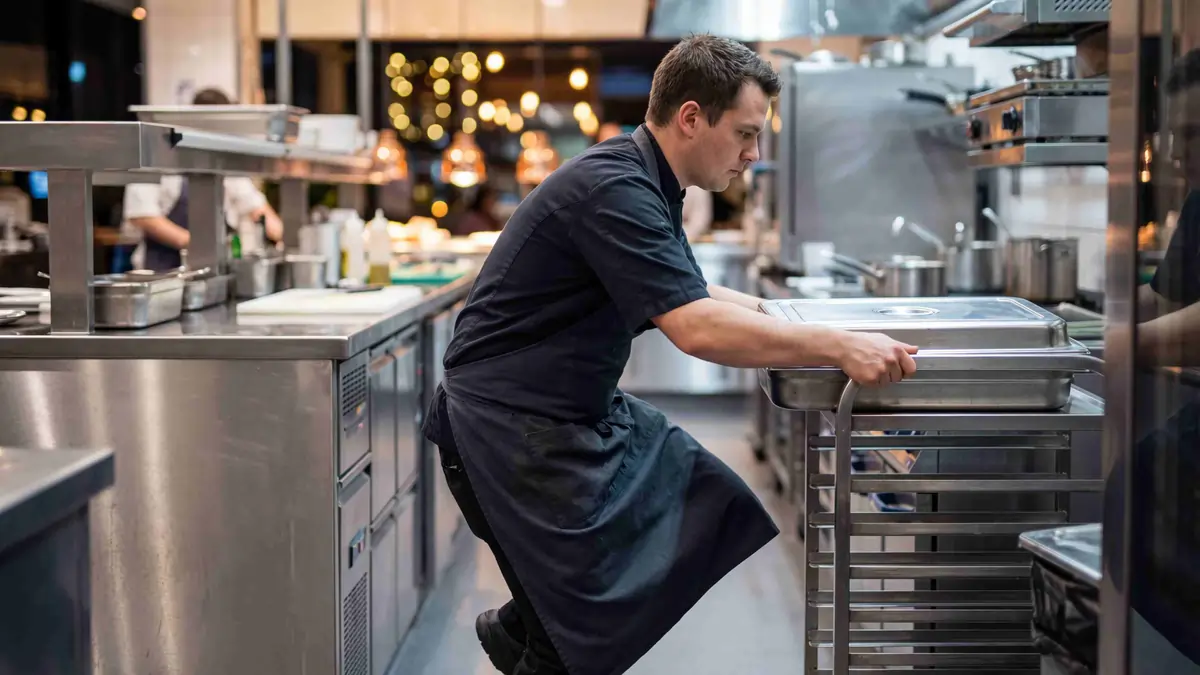
When a Lifting Injury Becomes a Food Safety Problem
Ask most catering business owners to list their food safety risks and you’ll hear the usual answers. Cross-contamination. Temperature control. Poor personal hygiene. Pest control.
- Manual handling rarely makes the list.
Catering tasks connect occupational safety with the conditions needed for safe food handling. Heavy or awkward containers, cramped routes and poorly planned deliveries can put staff at risk and disrupt food safety routines. The response should focus on the task and the support provided, rather than blaming an injured employee for a possible food safety failure.
This guide examines handling tasks in kitchens, bars, stores and event catering. It connects task assessment, equipment and work organisation with food safety procedures, so that improvements in one area do not create problems in another.
What Manual Handling Actually Looks Like in a Catering Environment
Manual handling isn’t just about heavy lifting. In a catering context, it covers a wide range of daily tasks across every area of the operation.
- Common Manual Handling Tasks by Area
- In the kitchen:
- Lifting 25kg flour sacks from floor-level storage to work surfaces
- Moving heavy stockpots filled with liquid across busy layouts
- Transferring 20-litre oil drums to refill fryers
- Loading and unloading walk-in refrigerators and freezers
- Repeatedly lifting mixing bowls filled with dough
- In front-of-house:
- Carrying multiple stacked plates, often with awkward reach
- Bar staff handling beer kegs, wine cases, and glass crates
- Catering teams setting up events with heavy equipment and furniture
- In storage and delivery:
- Accepting deliveries of beverages, dry goods, and fresh produce
- Moving stock from delivery areas to storage, often involving stairs or level changes
- Reorganising storage areas with heavy or awkwardly shaped items
- Moving bins and recycling to external collection points
These tasks should be examined in their actual setting. Frequency, posture, load stability, hot contents, space and floor conditions can change the risk even when the item appears familiar.
A Typical Scenario, The Flour Sack Problem
Consider a task that happens daily in bakeries, restaurants, and hotel kitchens across Ireland: moving 25kg flour sacks from ground-level storage to the prep station.
- The manual handling risks:
The risk depends on more than weight: assess posture, frequency, grip, route and the person’s capabilities. There is no universal safe lifting weight for every worker and task.
- Awkward, unstable sack shape is difficult to grip
- Repetitive lifts across a single task
- Often performed in cramped conditions with limited space for proper technique
- Reducing the Risk: Practical Solutions
- Practical solutions for this specific task:
Consider smaller pack sizes where they reduce the assessed risk without creating a different problem through increased frequency or handling.
- Provide a wheeled trolley for transporting multiple bags
- Redesign storage layout to reduce the vertical range of lifting
- Install adjustable-height shelving
- Provide task-specific instruction, practical training and supervision for handling that remains after controls are introduced.
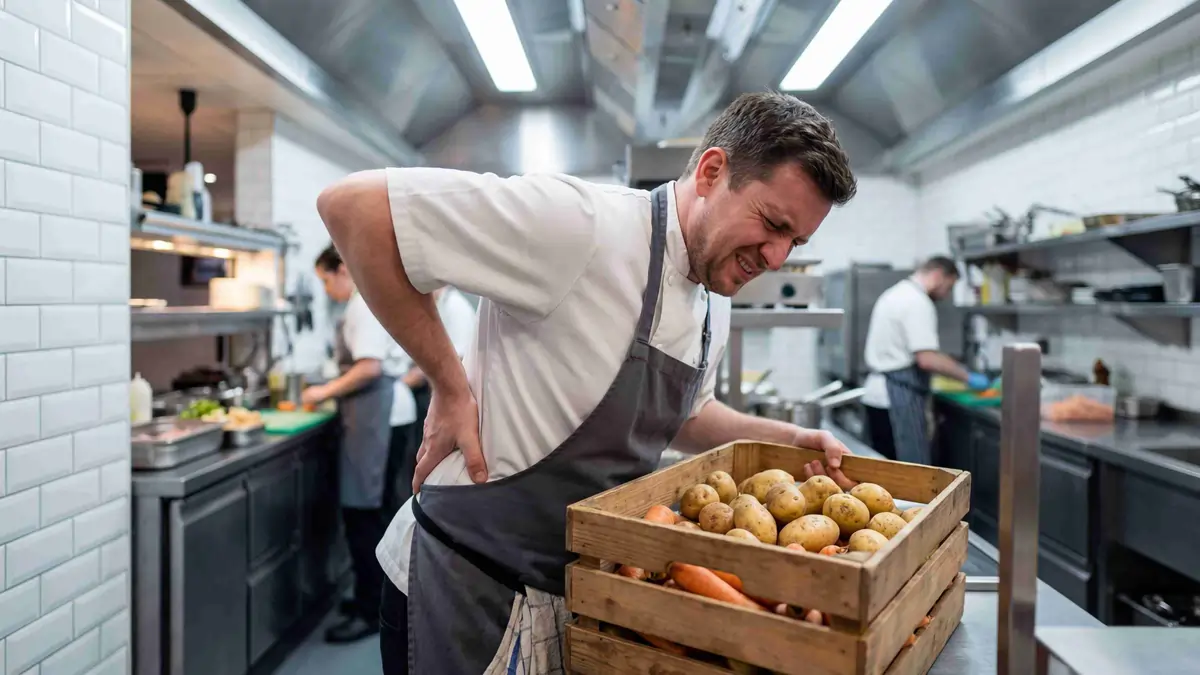
The Urban Catering Challenge, Dublin and City-Centre Operations
For catering businesses operating in Dublin and Ireland’s other urban centres, manual handling risks are compounded by the built environment.
Many city-centre restaurants, cafés, and catering operations work in older buildings with narrow staircases, basement kitchens, limited storage requiring vertical stacking, and no goods lift. Although these constraints can’t be wished away, they make careful risk assessment and creative solutions more important, not less.
Include new starters, temporary staff, different shifts and language or accessibility needs in the assessment and training plan. Do not assume that experience in another kitchen means someone understands the local route, equipment or procedure.
Where space is restricted, examine deliveries, storage and the sequence of work together. Training should support the redesigned task rather than compensate for an arrangement that remains unsuitable.
Applying the TILE Framework in a Catering Context
TILE—task, individual, load and environment—is a useful prompt for examining handling. It does not replace a competent assessment or a decision about the controls needed.
Task — What does the job involve? How many times per shift does this happen? How far does the load need to travel? Is it during service rush or prep time? What are the floor conditions along the route?
Individual — Consider the person’s capability for the specific task, relevant experience, training and support needs. Provide a route to report discomfort or difficulty and obtain appropriate advice on work adjustments where needed.
Load — What is being handled? Weight and shape. Temperature is this a hot pan, frozen goods, or a sloshing liquid? Grip availability smooth-sided oil drums and wet produce crates both present grip challenges. Is the packaging intact?
Environment — Where is this happening? Floor surface is it wet, greasy, or uneven? How much space is available? What are the lighting conditions? Is there a temperature extreme (moving from hot kitchen to cold storage)? Are there level changes such as steps or thresholds along the route?
Use the findings to decide how handling can be avoided or reduced and how remaining risks will be controlled. Record the actions, responsible person and review arrangements.
Practical Solutions for Common Catering Manual Handling Risks
- Heavy flour sacks
- Consider smaller packs following assessment of the complete handling task.
- Provide a wheeled trolley for transport
- Adjust shelf heights to reduce the lift range
- Schedule flour handling away from peak service times
- Oil drums
- Use pump systems to transfer oil where possible
- Specify drum-handling trolleys with proper wheels
Assess whether the task needs a suitable aid or another method; do not assume that two people automatically make an unsafe load safe.
- Ensure the route is clear and dry before moving drums
- Stockpots
- Install pot fillers at cooking stations to eliminate carrying water
- Provide wheeled pot carriers
Review the container, fill level, temperature, stability and transfer method. Avoid creating additional hot-liquid handling risks when changing the process.
- Designate clear routes during stockpot movement
- Beverage deliveries
- Negotiate smaller delivery units with suppliers
- Provide appropriate trolleys for different load types
- Schedule deliveries when adequate staff are available
- Establish a designated delivery-handling procedure rather than using whoever is closest
- Event setup
- Invest in wheeled equipment wherever possible
- Use collapsible or modular equipment to reduce individual unit weight
- Brief staff before each event on the manual handling approach
- Review events afterwards what created unexpected handling challenges?
Legal Obligations for Irish Catering Businesses
The HSA’s approach is to avoid or reduce hazardous manual handling through appropriate organisation and equipment, assess tasks that remain, and provide suitable information and training. Examine practical changes such as layout, delivery arrangements, pack sizes and handling aids.
Assess the actual manual handling tasks that remain and record the controls needed. Communicate the arrangements and review them when work changes or evidence shows they are ineffective.
- Connect the findings with the workplace risk assessment, Safety Statement, procedures and training arrangements.
Integrating Manual Handling Into Your Food Safety Culture
The most effective catering operations don’t treat manual handling and food safety as separate compliance obligations. They understand that the culture supporting one reinforces the other.
That means management visibly modelling safe behaviours not just signing off on the training records. It means daily briefings that treat physical safety and food safety with equal seriousness. It means staffing levels that allow people to work safely rather than rushing and taking shortcuts. It means near-miss reporting that covers both domains.
Your Manual Handling Implementation Roadmap
Assessment: identify lifting, carrying, pushing and pulling tasks across the operation. Review relevant records and consult the staff doing the work.
Priorities: assess the significant tasks and identify how handling can be avoided or reduced. Address urgent risks immediately rather than waiting for a staged project timetable.
Controls: select and introduce appropriate equipment, layout or purchasing changes. Test the complete task and update the working arrangements.
Learning: provide the information, practical instruction and supervision required for the remaining tasks. Check application and record follow-up.
Review: observe the task, invite feedback and examine incidents or near misses. Reassess when products, equipment, layout or work patterns change.
Keep food safety controls workable during change
When a delivery route, storage position or handling method changes, check the food safety implications. Consider separation, cleaning, packaging integrity and the time food spends outside its controlled storage. A trolley that reduces lifting also needs to be suitable for the environment and maintained in a usable condition.
Plan cover for absences and provide appropriate support when an employee reports difficulty. Supervisors should know who can perform each task and what instruction or adjustment is needed. Avoid pressuring staff to conceal discomfort or continue a task they cannot perform safely.
Use the corrective-action guide when an event affects food, and the food safety culture guide to support clear reporting and follow-through.
Choose task-relevant support
The HSA manual handling guidance is the official starting point. Our manual handling injury prevention guide explains the wider approach, and workplace risk assessment covers recording and review.
Review the current manual handling course and confirm how assessment and workplace instruction will meet your needs. For help with the arrangement of catering work, contact AcornStar.
Put the guidance into practice.
Discuss the training and procedures your team needs for its everyday work.
Talk to AcornStar →